Is the Hyperlite Unbound Ultralight Tent the Ultimate UL Setup?
There are plenty of ultralight tents available these days, and all of them claim to be the best. So we tested the iconic Hyperlite Unbound two-person tent to see if it stands up to the other UL backpacking tent options available (and whether we’ll pack it in our sub-9lb ultralight setup again). Here’s what makes the Hyperlite Unbound tent unique and what we thought of it and its functionality.
Looking for more ultralight backpacking gear? Check out our fave UL cook sets, UL trekking poles, and some of our favorite ultralight backpacking packs.

Hyperlite Unbound 2
The Hyperlite Mountain Gear Unbound 2p ultralight backpacking tent is a popular choice among die-hard ultralighters and thru-hikers for a reason: It’s durable, functional, light, and has plenty roomy for two backpackers and their gear.
Weight: 22oz
Price: $775
Size:
- Peak height: 48 in (122 cm)
- Floor width: 48 in (122 cm)
- Floor length: 7.5 ft (228.6 cm)
- Floor Area: 28 square feet (2.6 square meters)

Features
- Loops on the ceiling offer a place to string a laundry line or hang a headlamp
- Waterproof zippers
- Built-in vents at the top of each door
- D-shaped dual side-entry mesh doors
- Pockets under each door
- Easy pitch
- Magnetic door tie-backs + large cinch loop tiebacks
- Waterproof material by design (no DWR required) + taped seams
- Pockets under each door
- Not free-standing (you need to stake it out for a proper pitch)
- Pitches with 2 trekking poles that should extend to 48″
- Single-body design (fly and tent body are one)
- Doesn’t come with stakes

Function
But let’s break down how these features functioned in the real world.
Space
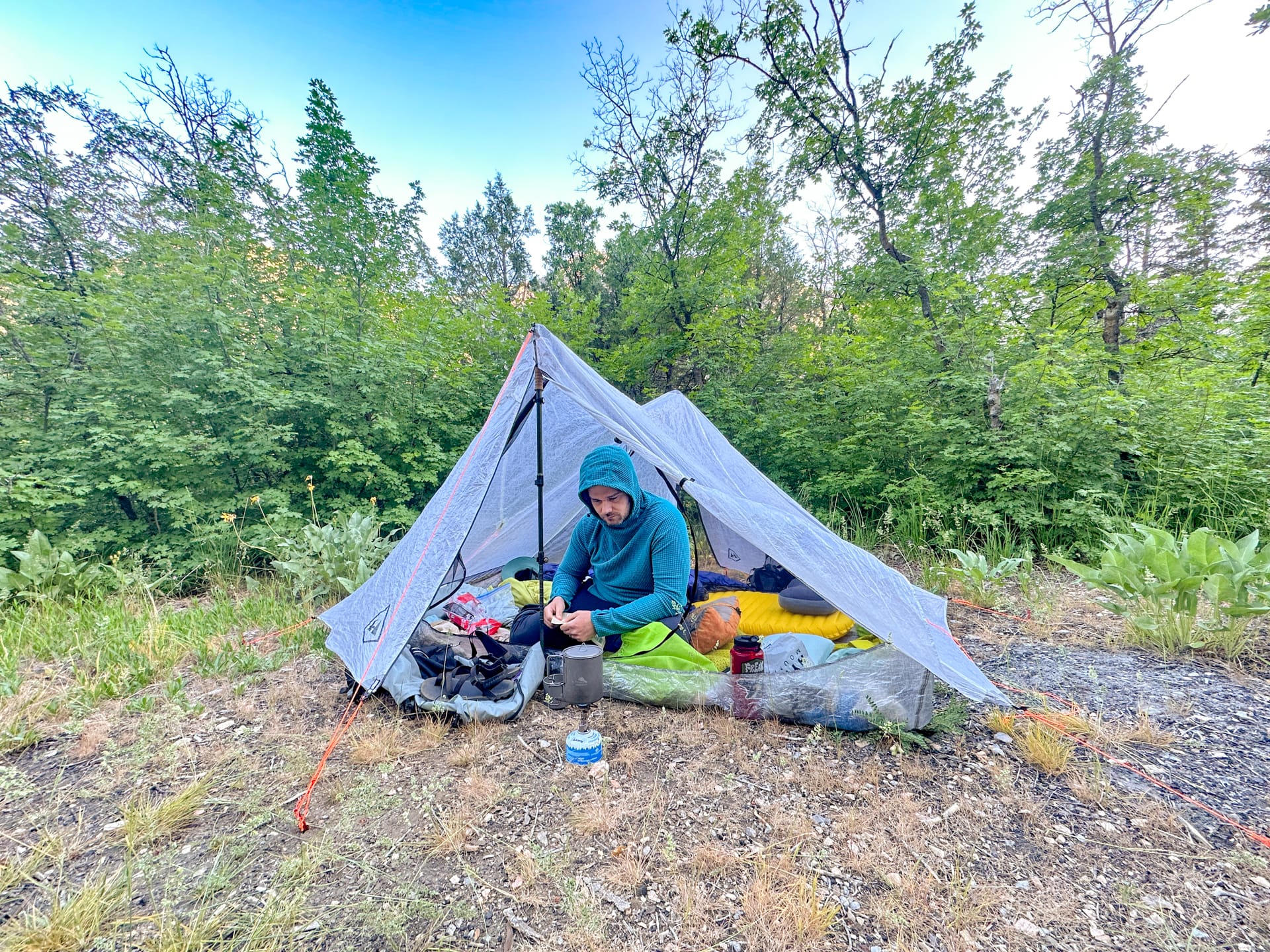
For starters, the Hyperlite Unbound 2 feels bigger on the inside than it looks from the outside. The headroom and footprint are generous. In fact, there was plenty of room for two to sit up, change, sort through bags, etc. We even had space at the head and foot of the tent for extra clothing, water bottles, and gear. The vestibules were plenty roomy enough for backpacks and dirty shoes and such, but honestly, we could’ve fit them inside the tent, too. There was even room on the sides for quick-grab essentials like a water bottle or headlamp.
We are smaller than average (5’3″ and 5’6″), but even with “regular” size sleeping pads we had no shortage of space. Even super tall folks should find enough space to stretch out, though backpackers who prefer extra wide sleeping pads may find it a bit cramped for two and may want to size up. Unfortunately, there’s not a 3-person version of this tent, so you’d have to go quite a bit larger with the Ultamid 4 Pyramid Tent.

Door Design & Entry
The Unbound features D-shaped doors, one on each side. The doors open on opposite ends of the tent, which promote more of a head-to-foot sleeping arrangement with your partner. Naturally, you can sleep in whatever direction you want, someone will just have to crawl a little farther to get out of their door. The doors are spacious enough and unzip a decent way across the bottom of the tent above the bathtub floor and extend nearly to the peak above the trekking pole support, so there’s plenty of space to crawl out next to the trekking pole support.
As for the vestibule doors, the Unbound has a waterproof zipper on the outer doors. That helps ensure rain won’t blow in. That said, waterproof zippers can be finicky and delicate, so take care of them. Also worth noting: there are clips on the corner of each vestibule door so you can swap which one is clipped onto the guy line (to stay in a closed position) and which you want to open. You can also unzip both doors on both sides to create a wide open, unobstructed path through the tent, which we loved on sunny days.

Pitching + Structure
Pitching the tent was straightforward. The tent sets up nice and taut with the use of two trekking poles and 6-8 stakes. It gets a little floppy with the doors open, but that’s pretty common with many tents. It requires at least 6 stakes (no, this is not a freestanding tent), but you can use two more to further stake out the roof guy lines for more headroom.
We also loved the bright orange cord used as guy lines—they’ve got reflective details, which is useful at night and are easy to spot in the daytime so you don’t trip over them constantly. And to simplify how many lines there are, the doors have a single support line with dual adjusters on top and on bottom to really dial in tension individually on both the top trekking pole tension and angle and the bottom of the vestibule doors. Super clean.

Ventilation + Waterproofing
As for breathability, There are built-in and permanently open vents at the top of each vestibule. That helps promote air flow and breathability, especially when paired with the mesh ventilation strips at the head and foot. The tent side walls are also made entirely of mesh, so lack of airflow was never a problem. Though on a warm, humid, rainy night, it wasn’t enough to prevent some condensation from building up on the ceiling. But that’s single wall tents for you; in damp conditions interior condensation will often be an issue.
As for how the rest of the tent performed in the rain, the mesh venting at the ends is narrower and pinches up near the corners to help reduce splashback from rain, but the extended foot of the walls doesn’t extend super far and so we still experienced some muddy splash back into the head and foot of the tent when the rain fell. Also worth noting: rain falling on Dyneema is super loud–much louder than on polyester or sil-nylon tents.
That said, Dyneema itself is inherently very waterproof, which means you’ll never have to re-waterproof your tent again. On the flip side, the tent was extremely hot when sealed up on a sunny day. Climbing in with everything zipped up felt like entering a sauna.

Privacy
The Dyneema material the tent is made of is thin. That means privacy could be an issue. During the day and at night with a light on inside, shapes and outlines are visible from the outside. So if you’re with a group and modesty is of utmost importance, maybe just don’t press your bare butt up against the wall. On the upside, most of what anyone will be able to see most of the time is blurry outlines, not detail.
On the flip side, it’s kind of nice to be able to see the faint outlines of trees and the world outside your tent when you’re in it.

Interior Details
Details matter when it comes to making a good tent a great tent, and the details here are mostly spot on. The magnetic door tie-backs for the exterior fly doors are a welcome feature and I wish every tent had them. The mesh door tie-backs aren’t magnetic, but they’re easy to use—even with gloves on—thanks to a nice big loop and cinch cord.
There are also three loops on the ceiling. The center one is big enough to thread some headlamp straps through for a makeshift lantern or you could hang a clothesline if it’s rainy out. Very handy.
The accessory pockets are another story. There is one pocket on the middle of both sides of the bathtub floor right behind the trekking pole supports. I understand why they’re there–to offer storage space no matter where you put your head–but they’re essentially useless. As soon as you unzip the mesh doors they flop to the floor of the tent and are even a big saggy when everything is buttoned up. Plus, if there are two sleeping pads inside they press up against the pockets and make them basically inaccessible. We love a good tent pocket, so we’re disappointed this is what UL tents seem to be doing.

Bottom Line
Overall, the Hyperlite Unbound 2P tent holds its own for UL backpackers looking for a tent with thoughtful features, solid construction, and clever design elements. We especially love the tight pitch, ease of use, and interior space. We love less the pockets and the fact that splash back during a rainstorm dampened gear at the head and foot of the tent. But overall, this is absolutely a tent we would pitch over and over again. It’s well designed, packs up small, ultralight and ultra spacious and the ultra durable materials will last for years, maybe decades (which is good, because the tent is not a budget buy).
The price will likely turn off some backpackers, in which case those folks should check out our review of the much more affordable Durston X-Mid 2, but it’s certainly an investment in quality and longevity. So if you can swing it, chances are you won’t have to buy another tent for decades depending on how often you use it.
How it’s sustainable: Waterproof by design and never needs re-waterproofed, PFAS-free, made in North America (Mexico).
Pros
- Tight pitch
- Waterproof zippers on fly
- Bathtub floor prevents most rain splatter
- Mesh venting at head and feet
- Lots of headroom
- Easy to use tie-backs
Cons
- Semi-transparent walls
- Doors open at opposite ends
- Floppy interior pockets
- Expensive
Looking for another UL Dyneema tent? Check out our review of the Zpacks Duplex tent HERE.