Bluetti Elite 100 V2: The Only Portable Power Station You Need

There are a lot of power stations out there to choose from. Maybe you’re looking for one to act as an emergency backup for your house. Maybe you want one for camping or road trips, or maybe you just want something to power lights and speakers in your backyard when there’s no power available.
After several months of real-world testing, I can confidently say The Bluetti Elite can do all of those things and much, much more. From powering our electric cooler on road trips to charging all of my camera gear (trust me, it’s a lot) and keeping our home fridge cold during a power outage, we’ve put this thing through it’s paces. Here’s what makes it so great and whether you should consider adding it to your gear closet.
BLUETTI Elite 100 V2 — Tech Specs
Specs shown are manufacturer-stated for the Elite 100 V2.

- Capacity
- 1,024Wh (20Ah)
- Inverter Type
- Pure Sine Wave
- Output Power
- 1,800W total, 120V, 15A
- Surge Power
- 3,600W
- Ports
- 1×100W max, 1×140W max
- Ports
- 2×15W, 5V⎓3A
- Car Socket
- 1×12V⎓10A
- DC5521
- 2×12V⎓5A
- AC Input
- 1,200W max, 10A
- AC Input (Charge+Bypass)
- 1,800W max
- Solar Input
- Up to 1,000W (12V–60V, 20A max)
- Charging Options
- AC / PV / Car / Generator / AC+PV
- AC Charging Time
- ≈45 min to 80%, ≈70 min to 100%
- Solar Charging Time
- ≈70 min to 100% (ideal conditions)
Times are estimates and vary by environment and equipment.
- Type
- LiFePO₄
- Cycle Life
- 4,000+ cycles to 80% capacity
- Shelf-life
- Recharge to 40–60% every 3–6 months
- Management
- MPPT Controller, BMS, etc.
- Connectivity
- Wi-Fi / Bluetooth
- Weight
- 11.5 kg (25 lb)
- Dimensions (L×W×H)
- 320 × 215 × 250 mm (12.6 × 8.5 × 9.8 in)
- Noise
- ≈30 dB
- Charging Temp
- 0°C to 40°C (32°F to 104°F)
- Discharging Temp
- −20°C to 40°C (−4°F to 104°F)
- UPS Switching
- ≤10 ms
- Warranty
- 5 years
Run-time examples assume ideal conditions and typical use; real-world results vary.
Putting it to the Test
I've made a habit of taking this thing with us on every road trip. Most recently, a 10-day road trip to all of Utah's National Parks. We were camping but driving everyday, which meant that there were plenty of opportunities to recharge the Bluetti with the car's 12v DC. Amazingly, it only takes about 2 hours to fully charge on DC power and about 70 minutes on AC power. When we were at the campground we kept our electric cooler powered, charged our cameras, headlamps, powered camp lanterns, and phones (there are a couple fast charge USB-C ports on there).
If you prefer not to put the strain on your car but you need to charge the battery on the go (or at camp) you can always use solar panels. My guess is about 3-5 hours to fully charge using one of Bluetti's 350w solar panels.
The digital readout and button layout is simple and easy to read. It was slightly confusing because the DC button turns power on to the USB ports as opposed to having its own dedicated button. In any case, it was easy enough to figure out (there are only 3 buttons). If you want to get a little more in depth with it, you can download the Bluetti mobile app.
Honestly, there aren't a lot of cons with the Elite 100 V2 other than price (retail is $799 but can be on sale as low as $499). But compared to other brands its surprisingly accessible for a battery of this size with this many features.
The Ultimate Electric Cooler Companion
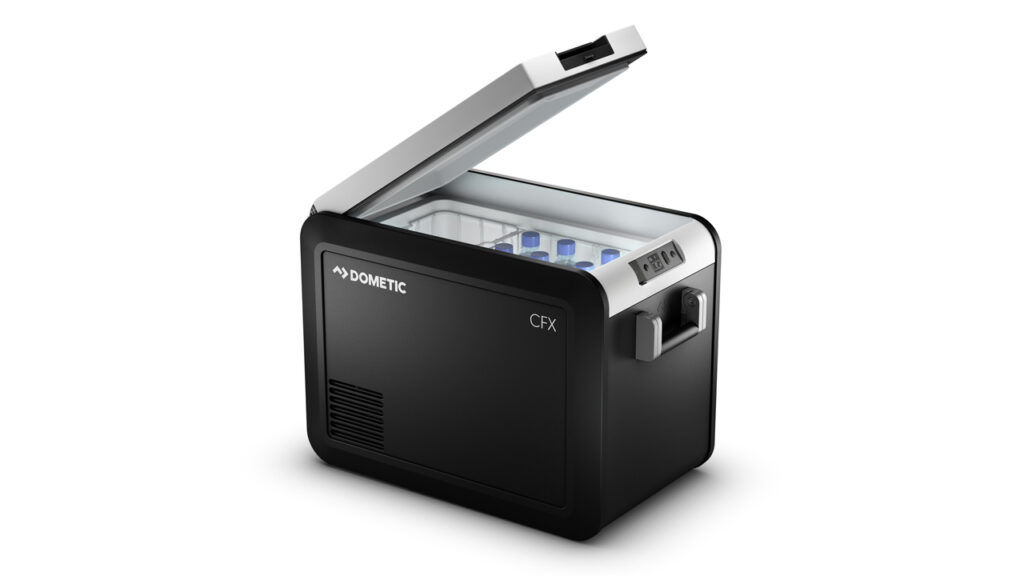
One thing we're almost never without on a long road trip is our Dometic Electric Cooler. With it plugged into our car's DC port we can keep fresh ingredients, stock up on hummus, and cook our meals instead of eating out all the time (and thus save some money). The problem? When we stop to camp or go into town, the cooler isn't getting any power. That's where the Bluetti comes in.
We've used other power solutions with our cooler before, namely the Goal Zero Yeti 500x. Unfortunately, the 500x only has enough juice (505 watt hours) to power the cooler for about a day, which means on a multi-day camping trip with our cooler we have to run the car to charge the battery back up and keep the cooler running. The Bluetti, on the other hand, is about twice the size at 1024 Wh, making it perfect for long road trips with a day or two of camping in-between (or a weekend getaway).
On these types of trips, I keep the Bluetti plugged into the car's 12v DC outlet (the DC adapter is sold separately) and plug the cooler into the Bluetti. This way whenever you pull off to get gas or grab a bite to eat, the cooler stays powered. When you get back on the road, your car will charge the power station back up. You can also charge it up with optional solar panels once you get to your campsite.
Power Everything–Not Just Your Cooler

Apart from keeping your beer (or sparkling water) cold, we've used the Bluetti Elite to charge just about every piece of gear we own: cameras, headlamps, phones, laptops, backup batteries, you name it. I've even boiled water in an electric kettle, which is an impressive feat considering smaller power stations typically can't put out enough watts for such a feat. Meaning we could easily make camp cappuccinos with this bad boy.
Power Outage at Home? No Problem.
I was extremely grateful for the Elite 100 a few weeks ago when the power went out at our house for about five hours. Not only could we plug our wireless router into it to stay connected to the internet so we could keep working, but it served as an emergency backup for our refrigerator so we didn't have to worry about ice cream and frozen foods going to waste.
What Sets it Apart?

What sets it apart from competitors like Goal Zero? For starters, price. Goal Zero's current offering, the Yeti 1000x is a whopping $999 whereas the Bluetti Elite 100 V2 comes in at $799 (but often on sale for as little as $499 or $599) making it a significant value. What's more, the Bluetti has 4 AC plugs as opposed to 2 on the Goal Zero, and the Bluetti sports 140w and 100w USB-C ports, unlike the Goal Zero with 60w and 18w ports.
You'll have peace of mind with Bluetti's 5-year warranty, too (2-year for the Goal Zero), and their LiFePO₄ battery technology is more stable, less prone to thermal runaway (read: fires) and handles more abuse than traditional lithium-ion batteries (Goal Zero).
Bottom Line: Is it Worth it?
At $799, this isn't an inexpensive piece of gear. Luckily, you can often find the Bluetti Elite 100 V2 and similar models on sale, and if you can wait, you should be able to score one for a few hundred dollars off.
But is it worth the price? In my experience, absolutely. Not only have we charged everything under the sun, I've also powered high wattage lights in my detached garage (which doesn't have electric), used it to power camera equipment like lights out in the middle of nowhere, powered fairy lights during backyard BBQs...the uses are nearly endless. Then there's the peace of mind it brings as an emergency backup solution.
Based on its versatility, this is a piece of gear just about anyone would find beneficial and one we never want to be without.
Check out These Articles Next:
Nemo vs Exped Double Sleep Setups
Dometic Electric Cooler Review
4 Portable Power Banks for Camping