The 5 Best Ultralight Backpacking Tents According to UL Experts
Tents are one of the four heaviest items you take backpacking (along with your backpack, sleeping bag and sleeping pad). And many backpacking tents out there claim to be lightweight, but weigh up to four pounds! Not these superstars. These five ultralight tents are not only some of our favorites (we’ve tested them all and have been packing UL for years), but help keep your pack light so you can go farther, faster. Take a look to see which one might be right for you.
Looking for more ultralight backpacking gear? Check out our fave UL cook sets, UL trekking poles, and some of our favorite ultralight backpacks.
The Best Ultralight Backpacking Tents

Zpacks Duplex
Weight: 17.9 oz (without stakes)
Price: $699
Head to any long-distance trail and you’ll spot a Zpacks tent or four at every campground. They’re iconic for their light weight, ultra durable materials, roomy interior, and customization possibilities (like stringing a line across the interior of the roof). The bathtub floor, highly waterproof attributes of the Dyneema they’re made of and ease of use make them a shoe-in for long-distance hikers looking for a UL tent that will last 5,000 miles and beyond.
It features easily usable tie-backs, accessory pockets on each side (though they’re not imminently usable thanks to their position on the top of the bathtub floor), giant rainbow-shaped doors to make entry and exit easy no matter which way you’re sleeping and comes in several colors. Do take note: Dyneema is partially see-through, so this single-wall tent (the tent body and fly are one and the same) doesn’t offer the privacy of other materials.
The only minor gripe we have about this tent is the doors. Not with their functionality; we love the absence of zippers on the vestibule doors as waterproof zips are often the first thing to malfunction or need replaced on tents. On the contrary, it’s the fact that you have to pitch it with a specific end upwind if there’s going to be a lot of wind or rain. Since the doors close just by overlapping, if it’s raining and the wind is blowing, there’s a good chance moisture is getting inside. But as long as you plan ahead, it shouldn’t be a real issue (though the vestibule doesn’t extend very low to the ground so splash-back in the vestibules is a real concern). Important to note: the Zpacks Duplex does not come with stakes (you need 6-8).
Read our full review of the Zpacks Duplex HERE.
How it’s sustainable: Two year limited warranty, made in the USA, PFAS-free design, never needs re-waterproofed, comes with extra seam tape.
Pros
- Extra large rainbow-shaped doors for easy entry and exit
- Large, easily useable tie-backs
- Tons of headroom
- Easy to pitch
- Adjustment cords to cinch the floor toward the headwall in the rain
Cons
- Fabric is slightly translucent
- Loud when it rains
- Inconvenient storage pockets
- In wind or rain needs to be pitched in a specific orientation
- Expensive

Hyperlite Unbound
Weight: 22 oz (without stakes)
Price: $699
Hyperlite tents are also a dime a dozen among thru-hikers. And for ultralight backpackers, what gets a thumbs up from long distance backpackers is typically a solid choice for weekend warriors, too. The Unbound is no exception. It’s another single wall tent (the tent body and fly are one and the same), so it won’t breathe quite as well as double wall options in damp or humid conditions, but it’s ultralight, easy to pitch, and ultra durable Dyneema materials will stand up to plenty of abuse, it’s easy to repair, and it’s inherently waterproof.
The openings are flipped on each side, meaning they’re intended to encourage two occupants to sleep head-to-foot. That can create issues if you can’t find perfectly level ground, but sleeping in the same orientation wasn’t a dealbreaker. It features magnetic tie-backs, accessory pockets on each side (though they’re not imminently usable thanks to their position on the top of the bathtub floor), good-sized doors to make entry and exit easy and comes in two colors. Do take note: Dyneema is partially see-through, so this single-wall tent doesn’t offer the privacy of other materials.
In a rainstorm you can expect some splash-back into the tent since the walls don’t extend very far out from the head and foot of the tent, but it was fairly minimal even during heavy rain. Important to note: the Hyperlite Unbound does not come with stakes (you need 6-8).
Read our full review of the Hyperlite Unbound 2 HERE.
How it’s sustainable: Waterproof by design and never needs re-waterproofed, PFAS-free, made in North America (Mexico).
Pros
- Tons of headroom
- Easy to pitch
- Magnetic tie-backs are easy to use
- Ceiling loop offers a place to hang a headlamp
- Spacious doors
Cons
- Fabric is slightly translucent
- Loud when it rains
- Inconvenient storage pockets
- Expensive
Durston X-Mid 2
Weight: 38.4 oz
Price: $280
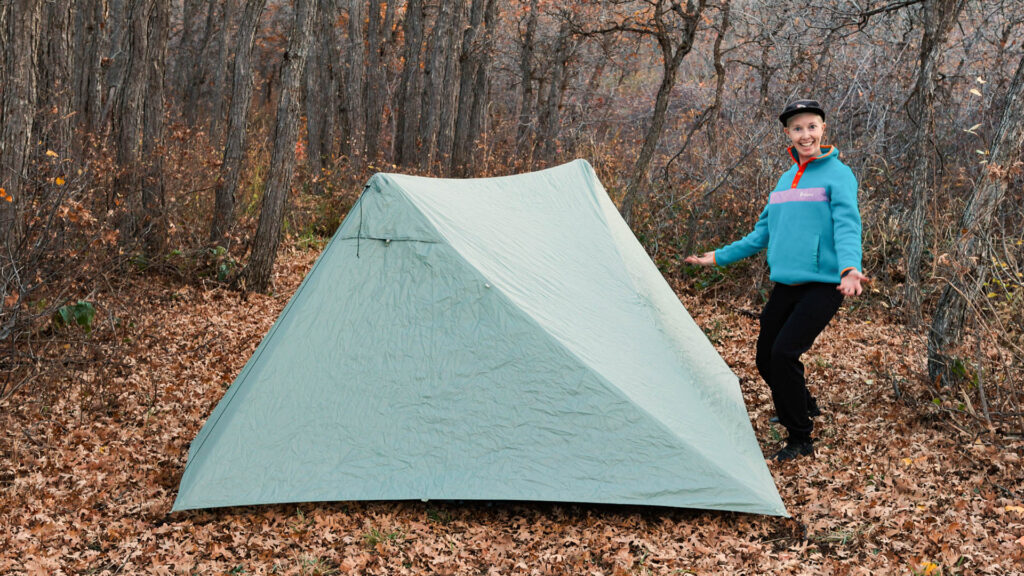
By far one of the most affordable ultralight backpacking tents on the market, it’s no wonder Durston tents are a cult classic, especially on long trails. Made not of Dyneema, but polyester, this double-wall tent (there’s a separate mesh tent body and solid fly) is imminently affordable (which is why it’s often sold out). Sure, the materials and spaciousness make it a touch heavier than some competitors, but if you desire a large, usable sleeping area, huge vestibules (bigger than any other UL tent we’ve ever tested), and the most protection from wind and rain thanks to a fly that extends nearly all the way to the ground, this is the one.
The walls are more opaque than options made of Dyneema, which affords more privacy if you regularly camp in a group setting or established campsites. There’s plenty of headroom inside, thanks in part to a unique offset pitch that allows two people to sit inside diagonally across from one another instead of directly across (which is great for playing games on rainy evenings). That does mean it’s set up more for head-to-foot sleeping arrangements, but sleeping head-to-head wasn’t a huge issue for two smaller sleepers.
It does have a much larger pitch footprint than other options, which could make it problematic for those who regularly camp in tight spaces in the backcountry or share small campsites with other tents, but we don’t think that’s a dealbreaker. Bonus: It comes with stakes!
Find our dedicated review of the Durston X-Mid 2 here.
How it’s sustainable: This tent is PFAS-free, doesn’t contain fire retardants, and the brand supports a number of nature-based non-profits.
Pros
- Lots of headroom
- Keeps out rain very well
- Two extra large vestibules
- Highly affordable compared to other UL tents
- Usable and convenient pockets
Cons
- Larger than average footprint
- Designed for two campers to sleep head-to-foot
- Slightly trickier to get the pitch right at first
- Heavier

Gossamer Gear The One
Weight: 17.7 oz (The Two is 23.5 oz)
Price: $255 (The Two is $320)
We tested the one-person version of this tent, but there’s also a two-person version, which is nearly identical except for the presence of a second door and vestibule (and it’s obviously bigger). Made of sil-nylon, The One is a single-wall tent that stands up well to wind and rain thanks to the bathtub floor and walls that extend far enough to prevent most rain splash-back on the ends. It’s lightweight, easy to pitch and use, has functional pockets, and comes with aluminum stakes.
The doors are a little smaller than some other options, but they don’t interfere with the trekking poles, so functionally they’re not all that different. But on the inside there’s plenty of room to sit up, move around and store gear that you may not want to leave in the vestibule. There’s even an interior clothesline across the top for hanging ultralight headlamps or clothes to dry. The One also fits taller campers better than some other one-person tents (and still leaves room down the sides for gear and movement).
Both vestibule doors can be tied back for big views, plus, The One is tiny. It weighs barely over a pound and takes up almost no room in an ultralight backpack.
Find our full review of The One here.
How it’s sustainable: PFAS free. Reportedly Gossamer Gear is releasing tents made of new recycled fabric this year.
Pros
- Good headroom
- Roomy for one
- Keeps out rain well
- Easy to pitch
- Less expensive
Cons
- Less durable materials than some other options
- Vestibule doors don’t extend all the way to the ground

Big Agnes Tiger Wall UL2
Weight: 35 oz
Price: $480
The Big Agnes Tiger Wall was our first ultralight backpacking tent and it’s a solid one. We do own an older version of this tent (pictured), but it’s only gotten lighter and more durable over the years, especially since Big Agnes switched to using their proprietary Hyperbead technology that made for lighter, stronger, and more waterproof fabric that doesn’t require regular chemical applications of fresh waterproofer.
It’s a semi-freestanding tent, which sets it apart from all the other options on this list. That means instead of pitching with trekking poles it utilizes a more traditional pole structure. That makes it a bit larger when all packed up, but not necessarily heavier (it’s similar in weight to the Durston X-Mid 2). It also means it’s easier to pitch on wooden platforms, sand, or rocky areas where tent stakes won’t securely hold the tent upright.
That said, there’s not quite as much interior space or headroom as trekking pole-pitched options. On the flip side, there are plenty of convenient pockets for storing accessories. And because the two-wall design allows you to pitch just the tent body without the fly, it’s an excellent choice for ultralighters who prize ultimate breathability and sky views on hot nights.
Check out our review from when we first tested the Tiger Wall here.
How it’s sustainable: Solution dyed, no re-waterproofing required thanks to new Hyperbead fabric that’s inherently waterproof, made of recycled nylon.
Pros
- Semi-freestanding means you can pitch practically anywhere
- Large doors
- Decent headroom
- Separate fly and tent body offer more breathability and pitch options (with or without a fly)
- Usable pockets
Cons
- Expensive
- Not as ultralight as some other options
- Slightly less packable
- Not as spacious

Bottom Line: Ultralight Tents
Choosing an ultralight backpacking tent is a personal decision. You need to take size, weight, function and details into consideration (and budget, of course) and then decide what features are a deal breaker and which you can live with since not all tents and designs will appeal to all backpackers. But hopefully we’ve helped you narrow it down to some seriously solid ultralight options so you can buy with confidence and camp happy. Now get outside and wander on already!
Remember: Take care of your tent, learn how to repair it, and if it’s time to get a new one, shopping used is the most sustainable option.