The Mountain Hardwear Alakazam 45L UL Backpack is Almost $600. Is it Worth It?
When the Mountain Hardwear Alakazam 45L backpack dropped earlier this year, to say we were intrigued is an understatement. The shiny new pack was ultralight, kitted to the gills with functional features that didn’t seem at all like overkill, and it was made of a new ultralight material, ALUULA, which seems like it’s raring to give Dyneema a run for its money. Plus, it’s one helluva looker.
But all that innovation comes at a price: the Alakazam 45L is nearly $600! So the question becomes: is this flashy ultralight pack worth the significant investment? We tested it to find out.
What is ALUULA?
First things first: What even is ALUULA (besides a delightful palindrome)? ALUULA Graflyte™is an Ultra-High Molecular Weight Polyethylene (UHMWPE), and it’s what makes up most of the pack body. If that sounds high-tech, it is. But in layman’s terms, it’s a super light, stupendously durable, weather resistant material that’s similar to Dyneema (a well-known UHMWPE material in the ultralight backpacking world), but designed to be recyclable.
That said, as we’ve written about before, recycling outdoor gear is tricky since one item (like a pack) is often made up of many different materials, making it difficult to separate for processing. That said, it’s at least a step in the right direction for a future that will hopefully allow for more easily recyclable apparel and gear.

Mountain Hardwear Alakazam 45 Review: An Epic Ultralight Backpack
You know we love a UL backpack here at Terradrift, and this one somehow manages to be comfortable, fully featured, good looking and capable of carrying slightly heavier loads, all for less than two pounds. We took the Alakazam backpacking in Utah’s Uinta mountains in rain and sun to see how it performed and if the new pack is worth the hype.
- Weight: 1 lb 12.2 oz / 800 g (45L), 1 lb 13.6 oz / 840 g (60L)
- Price: $575 (45L), $595 (60L)
Features
- ALUULA® fabric
- Gait Keeper™ hip belt design maximizes load carry efficiency and comfort
- Patented GiddyUp™ Compression System is fully modular
- Vest-style shoulder straps with dual drop-in pockets, secure zip pockets, and sternum straps with daisy chain webbing for strap adjustment
- Dual-density foam back panel and shoulder straps with mesh overlay improve airflow and dry quickly
- V-shaped aluminum frame attaches to hip belt at center back, distributing weight naturally to your lower body
- Large front stash pocket for additional gear storage
- Large side water bottle pockets with side access can fit tent poles, additional layers, and sleeping pads
- ALUULA® material bonds and welds to itself, reducing seams and weight
- Internal storage pocket
- Roll top entry for easy access and weather protection
- Load lifters for load carry adjustment
- Trekking pole loops with top cord keeper
- Dual vertical daisy chains

Size
The 45L pack (it’s also available in an Alakazam 60L version) comes in S/M and M/L to fit a range of body sizes (The 60L is available in XS/S, S/M, and M/L). We appreciate those sizing options as we are shorter-than-average hikers. In fact, we tested the S/M (I’m 5’3″ and Josh is 5’6″) and both found that size suitable.
What’s more, the waist belt ranges from 26″ to 50″ depending on what size you get, which is tolerably size-inclusive. That said, shorter plus-size hikers will still likely find it lacking in adjustability. And due to how far back the hip belt pockets sit, larger hikers may not find them as functional.
As for capacity, 45 liters is just the interior dimensions; thanks to capacious exterior pockets, there’s an additional 20L of space on the outside of the pack! In our opinion, that’s plenty big enough for most ultralight backpackers who have their kit dialed (which you should if you’re going to buy an ultralight backpack…).
The Alakazam is a bit heavier than more extreme UL packs like those from Zpacks or Hyperlite, but what it lacks in weight savings it more than makes up for in other ways like comfort and functionality (more on that to come).
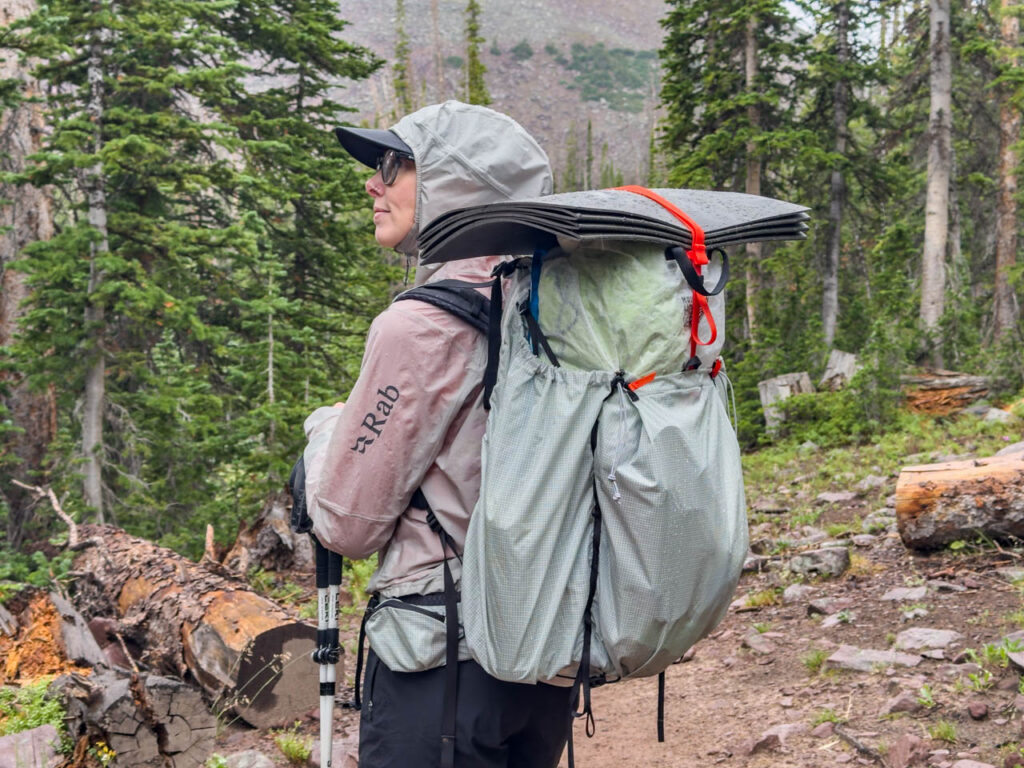
Also notable: even as a short hiker, when I had the pack loaded and a folding pad on top, it still didn’t hit me in the back of the head, which is a major win.

Fit + Comfort
This pack was impressively comfortable, which felt like a major departure from some of the other UL packs we’ve tested over the years that were, well, fine. On the contrary, everything about this pack seemed to fit just right with almost zero compromises.
The shoulder straps were lightly padded but still flexible, the hip belt flexible and adjustable, and two re-positionable sternum straps offered a fit more like a vest than typical backpack straps.
I will say that it’s possible that not all people with breasts will find the straps as comfy. I’m pretty compact in that department, but the straps did still press just outside my chest to the point where I could see larger-chested individuals might find them a bit compressive.
The hip belt didn’t cause any hot spots or pressure points, though, and had just enough padding to be comfortable, but still ultra flexible. The padded sections are on the narrow side and not terribly long, so wider hikers may find they don’t extend far enough forward, but I found them just right.
That said, it’s an ultralight pack meant to carry ultralight loads (less than 30lbs in my estimation), so it’s more for stabilization and light load transfer.

Speaking of the hip belt, it features GaitKeeper technology, which is Mountain Hardware’s trademarked way of saying “it shifts with you.” The belt is attached to a U-shaped frame that allows the belt to pivot side to side independently from the pack, allowing a crazy wide range of motion. Other packs have created similar functionality with more over-engineered designs (like the Aarn pack we reviewed), but this is just beautiful in its functional simplicity and allowed me to bend and tip at the waist without the pack shifting and twisting uncomfortably.
The minimalist frame and back padding offered the perfect weight-to-support ratio and adjustability was good across the pack, including via the dual sternum straps, load lifters, and adjustable shoulder straps. Then there’s the brand’s GiddyUp compression system: narrow webbing that zig-zags down the sides of the pack that you can adjust on the fly, reroute, and use to compress the bag if you’re not hauling a full load.

Functionality + Pockets
When it comes to functionality, there’s little to complain about with the Alakazam. There are plenty of places to stash things: in one super spacious expandable stash pocket on the front, two huge water bottle pockets on the sides, two hip belt pockets, and four shoulder strap pockets (two drop, two zipper).
The front stash pocket was plenty big enough for a multi-day first aid kit, camp sandals, and a rain jacket with room to spare. The water bottle pockets were large enough for tall 1L bottles or wide Nalgenes plus additional gear. The height of the pockets guaranteed nothing fell out when I bent over, but thanks to an additional vertical opening close to the back panel, I could still remove and replace most bottles while on the move.
I say most because my taller CNOC Thru Bottles were a bit too tall to easily slide out because they were just taller than the slits, but shorter bottles posed no issues.

The front pockets on the shoulder straps and hip belt were a mixed bag, though. I love shoulder strap pockets, but though these were stretchy, they weren’t large enough to fit a 500ml flask, small water bottle or iPhone 14 Pro. They were the perfect place to store snacks, electrolytes, and essentials like sunscreen, though. The zipper pockets were a bit larger. My phone did fit in those, as did more snacks, an ID and car keys.
As for the hip belt pockets, they were surprisingly small. Not enough to be a deal breaker, but they mostly fit one Clif bar or small essentials like an ultralight knife and lip balm. I do wish they weren’t located so far back on the belt. But I’m a fan of wearing a hip pack with my UL backpacks, so am fine doing that if necessary (or if I want a waterproof place to stash my phone).
Since compression straps are re-routable, the top strap is re-positionable and removable, and tons of daisy chains and attachment loops are located all over the bag, it’s impressively customizable. Remove them completely and you can shave a few more ounces of weight if desired.
Durability + Waterproofing
Frankly, I’m done with backpacks that aren’t at least water resistant. They’re a pain, require extra gear that doesn’t always work that well (pack liners or rain covers), and if they do get wet they’re extra heavy until they dry. Plus, I’m always worried about my stuff getting wet.
Not a problem with the Alakazam. It doesn’t claim to be fully waterproof (just water-resistant), but after several hours of hiking in steady rain, everything inside was still almost completely dry. Only a few spots on my sleeping bag at the very bottom of my pack were just damp enough to notice.
In fact, the back panel and bottom seemed to be the only place where any water crept in, and likely just because there are so many seams and attachment points there. Because ALUULA is inherently waterproof and can be bonded to itself in a way that creates waterproof seams, it reduces the need for seam tape or sealing and no moisture appeared to sneak through other seams.
The material is also crazy durable. Brambles, branches or brush won’t put a scratch in ALUULA, which is 8x stronger than steel by weight. The other fabric on the pack, including the ripstop nylon on the exterior pockets, is rugged, too, and I had no qualms about dragging it over rocks or scraping it against tree trunks. My money is on the fact that this pack will last for years if not decades.
Fortunately, there’s a limited lifetime warranty and the brand will even repair malfunctioning gear if possible (but normal wear and tear isn’t covered).

How It’s Sustainable
Most of the Alakazam’s sustainability comes in the form of durability. A pack that lasts and can withstand the abuse of the trail means less gear ends up in a landfill. Plus, because there’s no DWR to wear out, it never needs re-treated.
Mountain Hardware also supports a slew of non-profits, including Leave No Trace, No Man’s Land Film Festival, American Alpine Club and the Skin Cancer Foundation.
ALUULA fabric eliminates the need for adhesives, which can be environmentally harmful. The material is also recycle-ready, meaning it can be recycled at the end of its usable life––but the other fabric and components on the pack aren’t. We’re not yet at a place in recycling innovation where recycling a whole backpack is easily doable, but hopefully we will be by the time you burn through this pack.

Pros + Cons
Pros
- Comfortable
- Lots of accessory pockets
- Water resistant
- Removable and re-positionable webbing + straps
- Spacious interior
- Large exterior stash pockets
- Eye-catching color and design
- Durable materials
- Pivoting hip belt
- Lightweight
- Plenty of daisy chains for additional gear attachment
Cons
- Small hip belt pockets
- Shoulder strap pockets aren’t big enough for a standard 500ml soft flask
- Not fully waterproof
- Only comes in one color (not that we think that’s a drawback)
- Expensive
Is It Worth The Price Tag?
There’s a common saying when it comes to restaurants and food: there’s fast, cheap and good––and you can only have two of the three. That seems to go for backpacks, too: there’s ultralight, inexpensive and well-designed––and you can still only have two of the three. This pack is ultralight and well-designed, but it’s not cheap. Are there plenty of packs out there that are well-designed and less expensive? Or Ultralight and less expensive? Of course! But if you prioritize good design and light weight, this bag is top tier.
But whether the price tag is worth it depends on you and your preferences. And budget (obviously). If you’re the type who geeks out over new material innovation, packs that effortlessly walk the line between ultralight and ultra comfortable, and features and functionality that include everything you need and nothing you don’t, then this pack is nearly perfect and may just be worth the investment.
For those on a budget or who demand larger accessible pockets on shoulder straps and hip belts, the Alakazam will likely fall short. Might I recommend one of these other ultralight backpacks or that you keep an eye on used gear marketplaces for a rare deal?
As for me, the Alakazam likely just became not only my new favorite ultralight backpack, but the one Josh and I fight over before every multi-day trip. I truly love it.

Bottom Line
If you have the budget and are on the hunt for a near-perfect ultralight pack that’s also impressively comfortable, functional and customizable, the Alakazam is perhaps the most impressive specimen we’ve tested in a long time. Made of innovative materials and designed for durability, it’s not a budget-friendly piece of gear, but it is one you’ll likely find a joy to carry for years to come. Just don’t go into debt for a backpack, okay?
Wander on.